FAIR USE NOTICE


FOR EXTRAORDINARY HIGHLY SENSITIVE PERSONS

A BEAR MARKET ECONOMICS BLOG

OCCUPY YOUR SENSES AND SENSIBILITIES

This site may contain copyrighted material the use of which has not always been specifically authorized by the copyright owner. We are making such material available in an effort to advance understanding of environmental, political, human rights, economic, democracy, scientific, and social justice issues, etc. we believe this constitutes a ‘fair use’ of any such copyrighted material as provided for in section 107 of the US Copyright Law.

In accordance with Title 17 U.S.C. Section 107, the material on this site is distributed without profit to those who have expressed a prior interest in receiving the included information for research and educational purposes. For more information go to:http://www.law.cornell.edu/uscode/17/107.shtml

If you wish to use copyrighted material from this site for purposes of your own that go beyond ‘fair use’, you must obtain permission from the copyright owner.

FAIR USE NOTICE FAIR USE NOTICE: This page may contain copyrighted material the use of which has not been specifically authorized by the copyright owner. This website distributes this material without profit to those who have expressed a prior interest in receiving the included information for scientific, research and educational purposes. We believe this constitutes a fair use of any such copyrighted material as provided for in 17 U.S.C § 107.

Read more at: http://www.etupdates.com/fair-use-notice/#.UpzWQRL3l5M | ET. Updates

All Blogs licensed under Creative Commons Attribution 3.0

Saturday, December 20, 2014

Are You a Highly Sensitive Person? What You Need to Know About the Science of This Personality Type


  PERSONAL HEALTH  


Up to 20 percent of the population exhibits a trait that sets them apart. Scientists are finding out why.


Photo Credit: Shutterstock.com
Psychologist Elaine Aron has pioneered the study of a category of human personality that is generating considerable buzz both in the media and in the scientific community: the highly sensitive person (HSP). People in this group look the same as everyone else, but they don’t respond to the world the same. The way they think, work, feel, and even love is distinctive. Tendencies like acute awareness of emotions, heightened response to loud noises and other stimuli, and the deep processing of information are all things that set HSPs apart.
Want to know if you’re an HSP?  Take this online test developed by Aron and her husband, a fellow psychologist. Aron reckons that up to 20 percent of humans on the planet are highly sensitive, a trait that is found in animals, too. I spoke to Aron about what science has to say about HSPs, and how understanding how their brains are encoded may help society to better accommodate these people and make use of their considerable gifts.
Lynn Parramore: Research suggests that some people are genetically predisposed to high sensitivity. What scientific methods have been used to investigate?
Elaine Aron: There are two studies. One used was the more common method of looking for an association between a genetic variation and a personality trait. That is to take one candidate gene that we think is important for the personality variable; in this case, sensitivity. The candidate gene was a variation in the serotonin transporter gene, what is called the short-short variation, which refers to two short alleles, as opposed to one short and one long, or two longs. The short-short variation had been inconsistently associated with depression and other problems. It was seen as creating vulnerability. But many people with this genetic variation are not depressed, so researchers began to question their understanding of it, and found in numerous studies that it actually bestows many advantages. It only caused trouble when carriers had had a stressful or unsupportive childhood, or else, in some cases, were immersed in stressful life events.
This led, along with some other studies, to the whole subject of what is called differential susceptibility. People with this gene, or with certain behaviors, such as cautiousness or physical or emotional reactivity —all signs of sensitivity — do better than others in good environments and worse than others in bad ones. That’s an important concept for us. It’s mostly been studied in children, and if they have grown up in a supportive environment or there’s an intervention to help their parents raise them, they actually turn out better than other children in social competence, academic performance, health  — all kinds of variables have been looked at. It’s becoming a very popular thing to study. If children don’t have that supportive environment, then there’s depression, anxiety, and shyness and all of that. So sensitivity does not lead to vulnerability. It leads to differential susceptibility.
In the meantime, in China, some researchers were looking at sensitivity that other way, by looking at many genes at once to see which ones if any are associated with the variable of interest, in this case sensitivity. They chose high sensitivity because until then studies were finding unexpectedly low associations between genes and personality traits, such as introversion or neuroticism. That was surprising, because we know that a large percentage of personality overall is contributed by genes. We know that from comparing fraternal and identical twins. But we didn’t have a name for what those traits were that were encoded in the genes.
So these people in China looked at my Highly Sensitive Person scale and said, well, this seems to be deeply rooted in the nervous system. So they did the entire genome mapping of anything to do with dopamine. There are quite a few different dopamine genes, and they boiled it down to seven. And these gave a result more like what one would expect, given that we think personality is partly encoded in the genes. So what we are describing as high sensitivity is probably close to describing something that is actually genetically coded, in this case in seven variations of genes affecting the creation and transportation of dopamine.
We don’t know yet how those dopamine genes affect behavior. They’ve never come up before as being important for personality. These genes may reduce dopamine, or use it in a particular way that’s unusual. So the point is sensitivity is probably created by a number of genes, perhaps tending to be inherited together as a group. Or it may be that sensitivity has evolved along different routes, because if it’s a survival strategy — and it’s been found in over 100 species and probably exists in more —it may have landed in our species through several routes. Or there may be slightly different kinds of sensitivity, but not so different that the HSP scale [the test developed by Aron and her husband] doesn’t tap it.
LP: What evolutionary benefits might be associated with having this trait?
EA: Max Wolf, a scientist in Europe, did a computer simulation that did a very nice job of explaining why sensitivity had an evolutionary advantage. We knew that it had to because it’s found in such a large minority of people, 20 percent. It would have been eliminated long ago, or it would have been found in only a very small percentage of people, if it had no advantage.
Wolf did a computer simulation, kind of like a game, in which you had the choice of either noticing everything in every situation you encounter and using that information in the next situation you encounter, or basically assuming that your next encounter will be nothing like this one and not bothering to notice anything at all. In many situations, the next situation has nothing to do with the previous one at all. Other times there is a relationship. The simulation also assumes, rightly, that there’s a certain cost to having the more complicated nervous system of a sensitive person or a cost to using energy for paying attention to things. 
So there has to be a payoff at the other end.  Manipulating the payoffs and the costs in various ways demonstrated that it didn’t require much to make it pay to be highly sensitive.
But Wolf also made the interesting observation that the game doesn’t work if everyone is sensitive. His analogy is if there’s a patch of good grass, and every animal noticed it or smelled it or however they find it, then it wouldn’t be any advantage to any individual to carry this genetic variation. I joke that if I’m in a traffic jam and I notice a shortcut, it’s only useful to me as long as nobody else takes it. If all the other cars notice me turning and they follow me, then there’s no advantage to my noticing another way. There is now just as much traffic on my route as the other routes. The point is that we [HSPs] are invisible for a reason. All of us aren’t skinny. All of us don’t have curly hair or we’re not all left-handed or something that would make it easier to identify us.
Many people have thought about how it’s helpful to a particular species to have this trait. I think it’s kind of obvious in humans that some people spend more time reflecting — I use the term DOES: these people exhibit depth of processing (D), they are easily overstimulated (O), emotionally reactive and empathic (E), and sensitive to subtle stimuli (S). The only disadvantage is being overstimulated, which is the cost to us of being highly sensitive. But the rest of it has benefits. Yes, being emotionally reactive can be difficult, but it actually helps to motivate a person to think more!
LP: What implications does the science have for people who are highly sensitive?
EA: In the short run, HSPs need to see the research in order to believe the trait is real. Believing it is real can be difficult, because it is invisible and because the majority don’t have it, so we often grow up thinking, well, I should be behaving like everybody else. Or I shouldn’t be overstimulated right now. No one else is. I don’t know why I’m so tired. Why do I notice these things that other people don’t? Gee, I really have this great idea but nobody else really gets it. I’m pretty sure we should do this but nobody else seems to see why. Should I insist? No, I won’t, because I don’t want to make people mad. Now it turned out to be a mistake, and I knew it would be a mistake. So all of that self-talk makes us squash our sensitivity, especially men (there are equal numbers of highly sensitive men and women), and maybe not even think we have the trait.
Then when you also look at the research on the brain functioning, where we find that sensitive people have more activity in the neurons that have to do with empathy and just general consciousness, then we say, oh well, that’s not a bad thing to have.
The research also helps in a larger way, to help the rest of the world appreciate that the trait is real and has value. Most HSPs really do blend in, but a few with more problems—depression, anxiety, low self-esteem, health issues—are often the ones others notice, so that they think this is all there is to sensitivity. In fact, the majority is doing very well. I’m hoping that the research empowers sensitive people to be more themselves so that everyone can benefit from that — employers, spouses — everyone.
I’m also hoping that the research will help parents and teachers and pediatricians and also employers and policy-makers to create conditions that bring out the best in sensitive people because we see their differential susceptibility and we see how unusually well they can function in a good environment, and not so well in a bad one.
LP: What further research is needed for scientists to understand more about highly sensitive people?
EA: Well, with the children there has been considerable physiological research, but less of that has been done with adults. It might be interesting to see how sensitive people react in certain situations. Certainly we want to study the kinds of interventions that work for best for them. If they’ve had an unsupportive childhood, how can we alter the effects of that — in adolescence or whenever we can apply an intervention?
In terms of the brain studies, anatomical studies aren’t that helpful — looking at whether HSPs’ brains look different. What brain researchers look for is how do brains look different when they are doing a particular task. So we’ve given sensitive people and non-sensitive people a few tasks while having a brain scan (this is called functional magnetic imaging), but there are quite a few more that we could do.
Another interesting study would be would be to look at rejection or shame. We know the part of the brain that reacts to rejection or shame. We know that it’s the same part of the brain that reacts to pain. When we say someone has “hurt” feelings, we are literally talking about how it hurts in the brain. I’d like to see if that area is more easily stimulated in sensitive people, by subtle indicators. That would probably be helpful for seeing that this is normal for HSPs. Because when we do studies like this, we control for negative affect like depression or anxiety. So even if a person had a bad childhood, we’re sort of saying, OK, we’re going to take that piece out of your scoring on the test and then the brain scan and we’re going to see if you’re still that way in spite of taking that piece out.
If all sensitive people are more easily shamed than others, and I think they are, it would make evolutionary sense. We wouldn’t bother to study for a test if we weren’t afraid of being shamed for failing. So shame is another motivator. I want to do it right so that I’m not embarrassed or I don’t look stupid. Again, it makes sense that for a person to think deeply or notice subtleties, they would have to have emotional motivation of some kind to process things more carefully.
There are many other studies that could be done. I think it would be interesting to explore more how sensitivity is viewed in different cultures and different subcultures. Some has been done about this for men, but in general. The possibilities are vast, because this trait seems to affect almost all aspects of behavior in some way.  I even did a survey study of HSPs and non-HSP regarding their sexuality, and of course there were differences in what they liked and didn’t like, what life experiences they had had in this realm. The trait affects every sort of attitude and behavior.
Lynn Parramore is contributing editor at AlterNet. She is cofounder of Recessionwire, founding editor of New Deal 2.0, and author of "Reading the Sphinx: Ancient Egypt in Nineteenth-Century Literary Culture." She received her Ph.D. in English and cultural theory from NYU. Follow her on Twitter @LynnParramore.

Wednesday, October 29, 2014

How reliable is the knowledge provided by our senses?


theoryofknowledge.net


How reliable is the knowledge provided by our senses?


There are many different theories about how our senses actually work. Initially, that may seem surprising: surely our senses just communicate what’s out there, be it an image, a sound, or a smell, to the brain? But of course, the process is far more complicated than that, and the variables that are involved means that there is room for debate over what exactly happens. Moreover, just a quick glance at the perceptive abilities of animals quickly reveals just how limited our senses are: in terms of our eyes, for example, our lenses are not capable of dealing with objects at long distance, the twin images they then project onto the retina are tiny and upside-down, and the retina itself is pretty much colour-blind. The optical abilities of human beings, then, are very poor. So how do we see with any certainty? Where there is uncertainty, there are theories…


Herman Grid Illusion

Hermann von Helmholtz’s ideas

The first serious study into how the eye works was done by Hermann von Helmholtz (1821-1894). He was a German physician and physicist who investigated an unfeasibly large number of subjects, one of them being, the eye. Having decided that vision should be, physiologically speaking, all but impossible, Helmholtz ventured the theory that we construct images in our minds by inferring the whole based on past experience. In other words, we convert the shaky and rather inaccurate pictures generated by our eyes into something that makes sense based on our understanding of the world.

Verifying Helmholtz’s ideas

Scintillating Grid Illusion

These two optical illusions are probably familiar. The images show two different grids on top of a black background. The first, known as the Hermann grid illusion after its nineteenth century ‘discoverer’, Ludimar Hermann, shows a series of white lines on top of the background. Except, that’s not what you see. You see white lines with black blobs at their intersecting points. The second one, which is even more arresting, is known as the scintillating grid illusion, and was created in 1994 by Lingelbach. This has intersecting grey lines on top of the background with white spots at the meeting points of the lines. Except when you are not focusing on these spots, they turn black.

The precise way in which these illusions work is very complex, and certainly not worth going into. For our purposes, it is enough to say that we have trouble perceiving the true image because of the frailties of our optical sense. Our minds try to put a picture together for us to comprehend, but is unable to do so because of conflicting models of comparison. This makes more sense when we consider the theory that advanced the ideas of Helmholtz.
 

Gestalt Theory

The German word ‘gestalt’ means “form”, “figure”, or “shape”, and is the label given to a group of psychologists based in Berlin who were working during the 1920s – 40s. They agreed with the idea that we make a ‘best fit’ of images created by our eyes, and added that we do so by perceiving the whole, rather than little bits of the object we are looking at individually. We do this unconsciously and very quickly. The phrase stating that, ‘the whole is greater than the sum of its parts’ is associated with Gestalt psychology.

The simplest example of this is how we perceive words: we do not base our understanding of words by individual letters, but by perceiving words, phrases and sentences. It is only when you come across a word that you have not encountered before do you have problems with individual word.


Do you see the dog?
Do you see the dog?


This sentence has
has something wrong
with it.


If you glance at the sentence above, you don’t initially notice the extra word, and you certainly don’t have any problem understanding what its meaning is.

A more complex example is the picture on the right. If you look at its individual parts, it is very hard to make sense of. However, if you allow your eyes to take in the whole of the image at once, you are able to determine what its subject is.

It is, of course, a Dalmatian dog sniffing around underneath a tree whose leaves have dropped onto the ground.
 

Latest theories

The weakness of the ideas of the Gestalt psychologists is that they generally describe, rather than explain, how our senses work. Modern theories are based on the ideas of computational neuroscience, which uses computers to build up models of how the senses work, and allows scientists much more scope to come up with explanations of how the brain functions.

However, what the ideas do provide us with is a way of understanding how we do not receive an objective picture of the world, and how our vision of the world – even at the basic level of sense perception – is often varied and subjective, and dependent on our powers of reason and emotion, which is where we are going next.

Beau Lotto on sense perception


Beau Lotto’s ‘Lotto Lab’ is dedicated to exploring how and why we perceive the world through our senses in the way we do. Lotto’s ideas are founded on the principle that we have evolved a way of seeing the world that suits us best, and that we are very selective in the way we view the world. He argues that context is everything: our minds often trick us into seeing things based on previous experience.

Lotto’s inspiring TED talk can be seen here. Watch it, and you will literally not be able to believe what you are seeing.

Implications

The implications of these illusions should not be underestimated, and the ‘fun’ side of them shouldn’t overshadow the what their significance is. As Lotto explains, our brains only see what they want to see – conditioned by evolutionary instincts of survival – no matter what our reason tries to impose on our minds. In other words, what we see may not match up to reality at all.


Here are some more extraordinary illusions which our brains simply cannot cope with.


Do the horizontal lines appear straight? They are.


Do the grains of rice appear to be moving? They're not
Do the grains of rice appear to be moving? They’re not


Does the image look as though it is expanding? It isn't
Does the image look as though it is expanding? It isn’t


Stare at the cross for 10 seconds. Do you see a green dot moving around the circle? It isn't there
Stare at the cross for 10 seconds. Do you see a green dot moving around the circle? It isn’t there


Cite this page as: Dunn, Michael. How reliable is the knowledge provided by our senses? (10th May 2013). theoryofknowledge.net. 
 

Tuesday, October 28, 2014

Quantum Activism


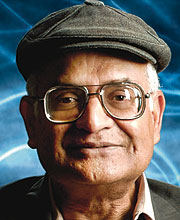
Meet Amit Goswami


Theoretical Quantum Physicist Dr. Amit Goswami is a revolutionary amongst a growing body of renegade scientists who, in recent years, has ventured into the domain of the spiritual in an attempt both to interpret the seemingly inexplicable findings of curious experiments and to validate intuitions about the existence of a spiritual dimension of life. A prolific writer, teacher, and visionary, Dr. Goswami has appeared in the movies What the Bleep do we know!?, Dalai Lama Renaissance, as well as the award winning documentary, The Quantum Activist (read more)

CPAK 2014 Conference on Precession and Ancient Knowledge | October 17-19 | Register at www.cpakonline.com

Ancient Wisdom Event Welcomes
Dr. Amit Goswami


The Conference on Precession and Ancient Knowledge (CPAK) brings together the leading scientists and explorers on the topic of "Ancient Wisdom in Pre-Dark Age Cultures." This year, the 9th Annual CPAK (October 17 - 19) will study the archeology, anthropology, language, science and spiritual practices of these cultures with the goal of better understanding consciousness in the higher ages.
Materialist Science
 

Materialist Science Isn’t The Whole Picture! What do we mean by materialist science? Materialist science takes it as its basic axiom that everything is matter. We have literally managed to train a whole generation of students on the idea that everything is material, but this Newtonian world view that has shaped our understanding for centuries is now giving way to the revelations of quantum physics which goes beyond materialism; to show that consciousness, not matter, is the ground of all being.
It's Objective and It's Scientific


You can call it God if you want, but you don’t have to. Quantum consciousness will do. Nonlocality, tangled hierarchy, and discontinuity: these signatures of quantum consciousness have been independently verified by leading researchers worldwide. This experimental data and its conclusions inform us that it is the mistaken materialist view that is at the center of most of our worlds problems today. To address these problems, we now have a science of spirituality that is fully verifiable and objective.

What is Amit Thinking About?


Manifest Your Dreams
When we think about cosmic ordering, we consider it to be the act
of placing an order with the universe and waiting to receive it. But, what is the key to unlocking its potential, and is it as simple as giving out good vibes and attracting them back – in a boomerang-like fashion? (read more)


Quantum Optimism
The metaphysics on which we base our perception of the world today is pessimistic. The metaphysics of scientific materialism that is now the foundation of all our sciences and social systems recognizes only the existence of matter, which necessarily limits our choices and therefore our ability to solve the planetary crises facing the human race... (read more)
It's Time to Walk Our Talk


More than just theory, quantum activism is the moral compass of quantum physics that helps  us to actually transform our lives and society.

’So let’s walk our talk, and make brain circuits of positive emotions. We just do it. We practice. Let some of us be good, do good. Be with God some of the time, be in the ego some of the time, and let the dance generate creative acts of transformation. With this resolution, with this objective in mind, I invite you to become Quantum Activists.’
A genuine paradigm shift. While mainstream science remains materialist, a substantial number of scientists are supporting and developing a paradigm based on the primacy of consciousness. Dr. Amit Goswami, Ph.D, a pioneer of this revolutionary new perspective within science shares with us his vision of the unlimited potential of consciousness as the ground of all being and how this revelation can actually help us to live better.

OPINION: 7 Categories of Dreams and Their Meanings


Define Your Dreams: 7 Categories of Dreams and Their Meanings


Dreams can have categories within categories that can be limitless. However, I have broken them down into seven easy to remember groups/categories that can be defined.  In my previous blog, I shared how you can dream your life to wellness by remembering your dreams.

http://www.patheos.com/blogs/aboveandbeyondthe5senses/2012/07/dream-your-life-to-wellness-in-6-easy-steps/

In this blog, I will discuss the seven categories of dreams, how to define them, and how they can overlap.


After you have remembered, and written down your dream in your journal, define it by using the information and definitions below.  Then look for validation within the dream to be sure you have defined it correctly.


1.)                          Daydreams- when you know you are awake but no longer focused on a task. Your mind wanders and you begin to get information. It could be answers to a challenge in your life or the solution to a job related problem. This state is much like a meditative or prayer state. Your Higher Power is always aware and listening.


2.)                          Lucid Dreams- you know you are asleep and dreaming.  This usually occurs just as you drop into a dream state after you go to sleep. With time and practice you can learn to control the outcome of these dreams and also make them emotionally or spiritually healing dreams.  This is especially true if they are recurring dreams. Change the ending or your reaction during a lucid recurring dream may solve the riddle in your life. One listener to my radio program said that she always had trouble falling asleep and never remembered her dreams, just that she woke up angry as soon as she had fallen asleep. As she worked on remembering her dreams by writing them in her journal and following the steps in my previous blog (link above) her father kept appearing in her dream and it would make her so angry she would immediately wake up. The next time her father showed up in her lucid dream she embraced him and told him that she forgave and loved him. She took control of her lucid dream and the angering recurring dreams stopped. That new ending was the key to her anger and difficulty sleeping riddle.


3.)                          Nightmares- who can forget that message. It is a way to be sure you remember all the important information necessary to solve a problem or work through a situation that could be life-saving. In my case it was a dream that started off as a spiritually guided lucid dream but turned into a prophetic healing nightmare when my guides turned into scary circus clowns while holding my mammograms. I immediately got the message and the details were impossible to forget. This prophetic lucid nightmare saved my life. I had stage four breast cancer that my doctors had missed in my mammogram.


4.)                          Recurring- because you did not understand the information the first time or solve the riddle of life. Remember, dreams speak to us with signs and symbols. If you keep missing the message, it may start to morph into a recurring nightmare.


5.)                          Healing-emotional or physical information to help heal yourself or a situation.


6.)                          Prophetic- dreams that come true and can be validated by facts, scientific tests, or life events. My prophetic dreams of cancer were validated by pathology reports.


7.)                          Epic- an entertaining storybook that you pick up and continue during sleep. It is a break from reality,  entertaining movie during sleep time. An opportunity for your inner children and imagination to play.

Dreams can be messages from the “other side” or just entertainment. We know the difference by validation within the dream. Keeping a dream journal will help you learn to distinguish between the different types of dreams and their messages.


We often forget that we are not human beings having a spiritual experience on the earth plane. We are spiritual being housed in a human body having a human experience. Our spirit is in this terrestrial world but not of this world. Therefore, we are partially extraterrestrial. Our dreams are our inner-ET phoning home for information or help dealing with human challenges. What is amazing is that someone on the “other side” always answers the phone. Categorizing and defining your dreams will help you remember the answers to your inner-ET’s questions.


Learn more about the author: Kathleen O’Keefe-Kanavos @ www.survivingcnerland.com  where you can follow her on Facebook, Twitter and LinkedIn.

Wednesday, May 21, 2014

6 Signs You Could Be a Highly Sensitive Person

Home

  PERSONAL HEALTH  


May 18, 2014

Psychologist Elaine Aron's research on a temperament category she describes as the "highly sensitive person" (HSP) has been gaining increased attention in recent years, and giving many people a big "aha" moment. Could you be among the 15-20 percent of the population she believes make up this group? I've learned that I am, and finding this out has changed the way I look at...everything.
When I was a kid, the taste of many foods was unbearably intense, and certain sounds were, too. I had a vivid imagination and experienced acute awareness of emotions — both my own and those of others. Yet I was not shy. Somtimes I would get so overstimulated I would find myself talking constantly, a tendency that earned me the nickname "Loquacious Lynn" from my mother and demerit points in school. I was transfixed by odd things: once, at summer camp, I stood paralyzed by the side of a stream, knowing that when I reached the other side I would be older and could never reverse the flow of time. I felt and saw things that enchanted and sometimes frightened me.
I grew up thinking I was most definitely weird, if not a tad crazy, and tried to send these peculiarities underground so I'd appear "normal." The effort was exhausting.
According to Aron, a lot of kids grow up feeling flawed (and perhaps medicated on that assumption) when they are not really flawed at all — they are just expressing a trait well within the normal human range: high sensitivity. In some cultures, such as Japan, the trait is highly valued, though sadly, this is often not the case in Western society, and such children can experience negative or confused reactions from peers and adults. In the 2011 documentary "Bully," a child who commits suicide in repsonse to bullying shows his first signs of being "different" as high sensitivity to loud noises, a fact no one comments upon as linked to his distressing experiences at school.
An HSP's temperament appears to be largely inherited (revealed through twin studies and other research), though environment plays a key role in how it develops. If the child is either overprotected or chastised for expressing what is for him or her perfectly normal, problems develop. Researchers who study the brain find that HSPs are aroused by stimuli that may not be detected by others and their difference has to do with how the brain processes information. They can't change what they are, though they can learn how to cope and monitor themselves.
High sensitivity can be seen in other higher animals, too. From an evolutionary standpoint, the trait is valuable in a group. While you don't want everyone, or even most members to have it, heightened sensitivity in some individuals is beneficial: They can warn of potential danger, make acute observations of the behavior of other animals, and share the wisdom of their tendency toward greater reflection. In history, HSPs would be the priest-advisors in the community. Today they are often the artists, teachers, researchers, and judges.
In the modern world, the trait has both positive and negative aspects. On the good side, you may be better able to spot errors and process information to deeper levels in your brain. On the bad side, you can react to false alarms and become rattled by loud noises and other stimuli. Caffeine and medicines may cause you to react more than most. Aron has also observed in her work that HSPs who had difficult childhoods are particularly prone to anxiety as adults.
According to Aron, this trait is not a new discovery, but it is something that has often been misunderstood and culturally devalued, making life challenging for people who live with it. Here are some things that tend to be associated with HSPs. (You can also take a self-test online.)
1. You were described as sensitive or shy as a child. You were the kid who knew what somebody was about to say before they said it. You reacted strongly to changes in your environment. Maybe you were the one who paused to watch before jumping into the game. Aron emphasizes that while most HSPs have been labeled shy, a full 30 percent have not and would be described as extroverted. She notes that some observers, like Susan Cain in her best-selling book Quiet: The Power of Introverts in a World That Can't Stop Talking, may really be talking about sensitivity when they discuss introversion. Being highly reactive to stimuli does not necessarily mean you don't seek out crowds or new acquaintances, although it often does. The key underlying trait is sensitivity, not inhibition. Some HSPs are actually sensation-seekers — stimuli can bring them intense pleasure as well as discomfort.
2. You pick up subtleties in your environment. The HSP's brain processes information and reflects on it more deeply. One thing HSPs share is the tendency to notice things others might not pick up on so readily, like the mood of a teacher or the rearrangment of furniture in a room. An artificial sweetener might taste like a chemical experiment, and someone's slightly off-key singing might sound like a fingernail on a chalkboard. HSPs might also have noticed a tendency to detect when someone is telling a lie, or intuit another person's feelings.
3. You can easily become overwhelmed. Too much intensity, chaos and noise can wreak havoc on an HSP, which is why they often work better in quiet environments. When they are able to concentrate, HSPs are excellent at work that requires deep thinking and fast turnover. But turn up the volume around them and ask them to do too many things at once and they become overloaded. If you're the kind of person who feels the need to retreat by yourself after a trip or an outing with friends or a busy day, you might be an HSP. Part of managing life for an HSP (or somebody who is close to one) is understanding and respecting the need for extra time to regroup and making allowances for your particular work style.
4. You fall hard and fast: Aron has devoted an entire book, The Highly Sensitive Person in Love, to the topic of HSPs and their style of loving. When they fall in love, they often feel tremendous ecstasy, and often very quickly, but they also feel anxiety, overstimulation and difficulty processing their intense emotions. Overstimulation and intensity can make intimacy difficult for HSPs, who are also the type of people who naturally seek it out. For HSPs, the risk of heartbreak and unhappy relationships is unfortunately higher than average, but understanding the trait and finding a partner who can be patient with it can increase the odds of success.
5. You are conscientious: HSPs tend to be conscientious people who try hard to perform their duties well and execute their work at their very best level. They often have particularly good manners, and notice when others don't. Rudeness and work that is full of errors drive them nuts. HSPs are often especially concerned with issues of social justice, and will fight hard to right wrongs in the world.
6. You have a vivid imagination: HSPs are often very creative people. They have vivid dreams and can wander off into imaginary realms in their minds. They are also very empathetic and can imagine the thoughts and feelings of others. An interest in art, philosophy and spirituality is common. Carl Jung was one of the early psychologists most interested in HSPs (he used a different term), probably because he himself was one. He thought that people with "innate sensitivity," as he put it, were more in touch with the unconscious mind and could be especially insightful.
If all of this sounds like you, you might just be a highly sensitive person, equipped with a temperament that requires special skills and knowledge to deal with. As I'm learning more about how this trait works in my own life, I'm grateful that Aron does not pathologize it, but treats it as something that simply is. Even for people who are not HSPs, information on the topic can surely be useful to parents, teachers, partners, and co-workers who have an HSP among them.
Lynn Parramore is an AlterNet senior editor. She is cofounder of Recessionwire, founding editor of New Deal 2.0, and author of "Reading the Sphinx: Ancient Egypt in Nineteenth-Century Literary Culture." She received her Ph.D. in English and cultural theory from NYU. She is the director of AlterNet's New Economic Dialogue Project. Follow her on Twitter @LynnParramore.

Saturday, March 8, 2014

Scientists Scanned A Woman's Brain During An Out-Of-Body Experience — And What They Found Was Amazing


YAHOO!

 Yahoo Finance

Scientists Scanned A Woman's Brain During An Out-Of-Body Experience — And What They Found Was Amazing


Business Insider
It may sound like the plot of the Twilight Zone, but a psychology graduate student at the University of Ottawa says she can voluntarily enter an out-of-body experience. This was a lucky break for scientists, who were able to scan her brain during the episode.

Usually out-of-body experiences are a part of, say, a near-death experience. A patient may float above their own body as surgeons work on them. These experiences are usually attributed to the drugs in a patient's system, or the hormones released into their system by trauma.

A unique experience 


The study — which only involved this one person — was published Feb. 10 in the journal Frontiers of Human Neuroscience, a peer-reviewed open access publication. The researchers are members of the School Of Psychology at the University of Ottawa.

According to the paper, this woman enters her out-of-body state right before sleeping, visualizing herself from above. She started doing so during naptime in preschool, they write. She currently only does it sometimes.

The researchers wrote in the paper:


She was able to see herself rotating in the air above her body, lying flat, and rolling along with the horizontal plane. She reported sometimes watching herself move from above but remained aware of her unmoving "real" body...

She told the researchers: 


I feel myself moving, or, more accurately, can make myself feel as if I am moving. I know perfectly well that I am not actually moving. There is no duality of body and mind when this happens, not really. In fact, I am hyper-sensitive to my body at that point, because I am concentrating so hard on the sensation of moving. I am the one moving – me – my body. For example, if I ‘spin’ for long enough, I get dizzy. I do not see myself above my body. Rather, my whole body has moved up. I feel it as being above where I know it actually is. I usually also picture myself as moving up in my mind’s eye, but the mind is not substantive. It does not move unless the body does.

The brain out of the body 


The researchers did a fMRI before and after asking her to enter her out-of-body state to find out what that looked like in the brain. They compared these to when she was imagining, but not actually entering, the state.

Interestingly, the pathway that seemed to be activated during her out-of-body experience is also involved in the mental representation of movements.

brain scan activated areas
 

Brain regions activated by the out-of-body experience include the supplementary motor area, the cerebellum, the supramarginal gyrus, the inferior temporal gyrus, the middle and superior orbitofrontal gyri.
Some parts of her brain involved in interpreting vision were turned down in activity, as shown below:


brain scan inhibited areas
 

Brain regions inhibited by the out-of-body experience include the visual cortex.
She didn't have any specific emotions surrounding this experience, and i t seems to be a kind of hallucination she can turn on at will.

What's happening?  


Even if there is no soul stuck in our bodies, this woman isn't making this up. There's obviously something happening in her brain that is making her experience the world in a different way — but researchers can't yet say exactly what it is.  Plus, this study was about one woman's out-of-body experience, not all out-of-body experiences. 

Still, the changes they observed could be similar to how the brain can be trained using meditation. The researchers even suggested that this could be something many kids can do, but that with practice could be carried into adulthood. 
Interestingly, the researchers suggested that this kind of experience may be much more common than we thought. The woman in question actually "appeared surprised that not everyone could experience this," the researchers wrote.

They compared it to synesthesia — the condition in which people hear colors or smell sounds — which was thought of as "out there" but has become widely accepted in the last few decades.

Saturday, February 15, 2014

ESP: Extended Sense Perception


http://www.unexplained-mysteries.com/


Unexplained Mysteries is always on the look out for new article writers and contributors. If you've written articles, reviews, news stories or other material that you would like published for free on the site then we want to hear from you - Click here for details.
  Columnist: Marc Berry

Image credit: stockxpert

ESP: Extended Sense Perception


Posted on Wednesday, 11 April, 2007 | 5 comments
Columnist: Marc Berry


As I have been ill for the last little while, my wife has kindly allowed me to present to you, dear reader, one of her articles. In legalese: this article is reprinted with permission. I hope you enjoy it as much as I do. CeruleanBlue: When most people think of ESP, they think of extrasensory perception and defining it as a sixth sense. However, if you look at the categories of this area of human ability they each fall into one of the five senses: Clairvoyance – sight, clairaudience – hearing, psychometry (to handle something and gain knowledge from that interaction) – touch. Smell and taste are not as well understood in the West, but we've all heard ourselves or someone else say that a situation "smells wrong", and maybe it does quite literally. But the main point here is that each one is not an extra sense; they are each an extension of an already known sense. There is another term often associated with this phenomenon; PSI. This word comes from the Greek word psyche meaning mind or soul. Substitute the current popular word – consciousness – and you have the mechanism: Consciousness, which doesn't have local interaction only restrictions, acting through a particular regular sense to gain feedback from the environment at a distance, whether in space or time.

The implications of understanding this frame of reference is that anyone and everyone is "psychic". In other words, if you have a mind and you have senses, you can reach beyond your immediate environment to gain information. Perhaps we are extending our senses into a pervasive holographic information field (see Double Slit Experiment under observation) and depending on the nature of the information, a particular sense becomes the receiver of that information. So if the nature of the encoded information is visual, we see it. If it's encoded in sound, we hear it. Perhaps the information has a strong texture, so we feel it and so on.

Of course there are crossovers such as sound that is felt rather than heard and others that can be interpreted by more than one sense as say smoke can be (seen, smelt, tasted and felt). It may actually be these that get us mixed results when we try to test for these abilities and this would be the majority of information in this field – holistic encoding if you will . Look at any life event, big or small, it happens in complete packets (moments): You don't suddenly go blind to get one moment and deaf to get the next. Now, if we think of each sense as a channel or frequency and we're only looking for information on one channel, trying to fine tune that pick up, we will tend to miss the bulk of what's available. So our own bias of how we think the information "should" be encoded, prevents us from seeing it as it really is. Basically we're determining our content , right or wrong (objectively not morally).

Now, this proposed holographic field may have a feedback feature to it that could be likened to a sort of conversation we have with it when we engage in getting knowledge from it (which, by the way, we do all the time consciously or not). To store, as it were, information in this way, could be said to be a kind of memory spread across time, forwards and backwards. What if this field were conscious itself? In the Double Slit Experiment, the end result would produce interference wave patterns, but if watched, marbles hitting a screen. Why would these atomic particles produce a holographic-like pattern when not observed, but when consciousness interacts with it the information seems to change its expression? By not taking in the whole did communication break down?

What if you took all the consciousness on the planet – and that's far more than just humans – and had it stream around in the electromagnetic field that's all over the world. Then add a consciousness that is focusing on something specific that stream is carrying, is electrochemical and can communicate through sound (see this story at CBC) with this stream – in effect being a perfect antenna and relay station – and you may have a reason for psychic phenomenon and synchronicity: Query and response. Communication that is a conversation, two way, and holistic. If we really learn how to do this, nothing breaks down. Instead, it connects.

MBerry is co-founder of NewBranes.com, a blog covering all aspects of the paranormal.

His ultimate long term goal is to discover the General Unified Theory of Everything Weird.

http://www.newbranes.com

Article Copyright© Marc Berry - reproduced with permission.